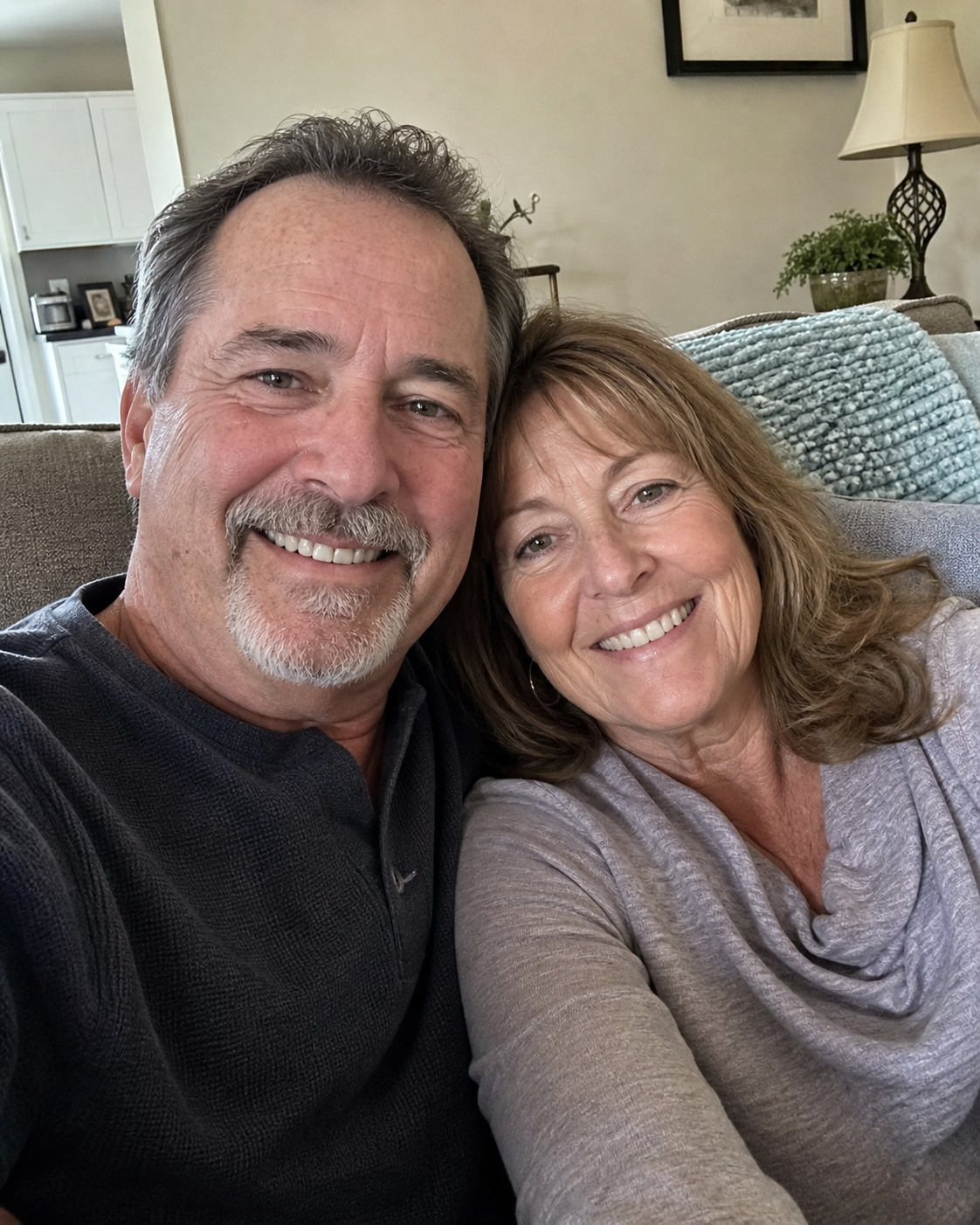
A personal story
What I Wish Someone Had Told Me Before My Wife's Diabetes Took Her From Me
Note: I share my honest experience here. This page contains affiliate links. If you decide to try what worked for us, I may earn a small commission at no extra cost to you. I'd never recommend something I didn't believe in.
If your wife sits on the couch at family parties because she's "just tired," I wrote this for you. Mine did too. I thought it was the diabetes. I didn't realize it was something most doctors aren't even looking at.
I'm a 61-year-old husband. Not a doctor. Not a researcher. Just a man who watched his wife disappear into something for two years before I finally found a question that nobody was asking.
This is the long version of what I figured out. If you're in a hurry, the short version is at the bottom, but I think the long version is what you actually need.
The morning my granddaughter asked the question.
Linda was diagnosed with Type 2 about three years ago. She did everything they told her. Cut sugar. Walked every morning. Took her Metformin like clockwork. Logged every meal in MyFitnessPal until her thumb hurt. Her A1C climbed anyway.
Her doctor added a second medication and said the line you hear at every appointment after a certain point: "We'll monitor it."
That's the line that breaks people. Not the diagnosis. The "we'll monitor it." Like the disease has already won and everyone's just keeping score.
Last June, our granddaughter turned seven. We had the party in our backyard. Cake on the kitchen counter, kids running around, my brother-in-law manning the grill. Linda spent most of it on the couch in the living room. Said she wasn't hungry.
About an hour in, our granddaughter walked over and stood in front of her and asked, "Grandma, why don't you play with us anymore?"
Linda looked at me. Her eyes were empty. She gave that little smile she'd been giving for two years. "Grandma's just resting today, sweetie."
That's when I understood the disease had been quietly taking her, and I'd been pretending not to notice because there was nothing I could do.
The summer I gave up.
By July I'd stopped suggesting things. No more articles. No more "I read about this new diet." I'd watched it crush her every time something didn't work: the keto attempt, the apple cider vinegar phase, the berberine that made her stomach hurt, the second endocrinologist who said the same things as the first. I told myself I was being a good husband by not pushing.
The truth is I'd given up. I started sleeping in the guest room some nights. Told her it was my back. It wasn't.
That's the part nobody tells you about diabetes. You don't lose them all at once. You lose them in pieces. A laugh you don't hear anymore. A trip you stop planning. A night where you reach for them and they flinch because their body is in a war you can't see. You don't notice until one day you realize you're already grieving someone who's still in the next room.
What I found at 2am.
I started reading at night after she went to bed. Most of it was the same advice she'd already tried. Lower carbs, more steps, the same supplements that hadn't moved the needle for her. But buried in research from the Salk Institute, research most diabetics never hear about because there's no medication tied to it, I found something I'd never heard anyone say out loud.
Diabetes might not be a sugar problem. It might be a switch problem.
Here's what I learned, in plain language: there's a switch inside your muscle cells, researchers call it AMPK, but you don't need the acronym to understand the idea. That switch helps decide whether your body burns sugar for energy or stores it as fat. When that switch is firing properly, sugar gets used. When it's stuck off, sugar piles up, and no amount of dieting fixes it because the dieting isn't the problem.
What stuck the switch off in the first place? Years of post-meal inflammation. Every time we eat, especially the modern processed diet most of us grew up on, our system stays in low-grade inflammation for hours. Over time, that quiet inflammation suppresses the switch. The body adapts. Sugar stops being burned. Type 2 diabetes is the result.
The medications they hand out don't address this. Metformin reduces sugar production in the liver. Other meds force more insulin or slow absorption. They manage what spills over. They don't unstick the switch. Which is why so many people get worse on them, not better, because the underlying cause keeps doing its work.
I read that twice. Then I read it ten more times. Because for the first time, I had an explanation that fit what I'd been watching for two years.
What I asked Linda to try.
I didn't tell her I was sure of anything. I told her I'd read about something that targeted the underlying mechanism and asked if she'd be willing to try it for thirty days with me. She said yes the way you say yes to a husband who's clearly out of options.
I won't make this dramatic. The first five days, nothing happened.
Day six. She read the meter twice. 142. She'd been at 178 for months. She looked at me and said, "Did this thing read right?" I told her I didn't know. We checked again that night. 138.
Week two. I caught her humming in the kitchen. I hadn't heard her hum in three years. I didn't say a word. I was afraid I'd jinx it.
Three weeks in. Our daughter came over for Sunday dinner. Halfway through the meal she looked at her mother and said, "Mom, you look different. Did you do something to your hair?" Linda laughed. Actually laughed. Our daughter's eyes filled up because she hadn't heard that laugh in I don't know how long.
Week six, at her checkup. Her doctor ran the bloodwork twice. Asked what she'd changed. Her A1C had dropped over a full point. He took her off her second medication that day. She told me later that she'd walked out to the car and just sat there. "The fear just lifted," she said. "I can finally breathe."
About two months in. She fell asleep against my shoulder watching some movie on the couch. I sat there for an hour after the credits rolled, just listening to her breathe. I'd forgotten what she sounded like sleeping next to me.
I had my wife back.
What she's been taking.
It's called GlucoExtend. A blend of natural compounds, twelve in total, built around an Alpine berry extract that's been used for centuries in some parts of Europe. The formula is designed to target that switch directly instead of just managing what spills over.
It's not a medication replacement. Linda still takes her Metformin. Her doctor reduced it, but she stays on a lower dose. It's a daily capsule. No diet rules. No protocol. Made in a third-party-tested facility in the United States.
What sold me wasn't a sales pitch. It was the 180-day money-back guarantee. Six months. If nothing changes for your wife, or for you, they refund every penny. That's the longest guarantee I've ever seen on a supplement, and the only reason a company offers six months is because they know what happens for most of the people who try it.
See if GlucoExtend is still in stock
The honest part.
I'm not going to tell you this works for everyone. I don't know that. I know it worked for Linda. I know it worked for hundreds of other people whose stories you can read on their site. I know the mechanism it targets is real and supported by published research.
I also know it might not work for you. Or your wife. Bodies are different. Diabetes shows up differently in different people. That's why the guarantee matters. Six months is enough time to know.
What I will tell you: don't wait until she's on her third medication and her doctor is mentioning insulin shots. There's nothing romantic about being the one watching it happen. I waited two years too long. I'm not going to dress that up as anything other than what it was: me being a coward and calling it patience.
This isn't about chasing some miracle. It's about a mechanism nobody mentions in a fifteen-minute appointment because there's no medication to prescribe for it. Linda's been on this for eight months now. Her A1C is the lowest it's been in three years. She's down to one medication. She laughs again.
There's nothing to lose except more time watching someone you love disappear into something you both could have stopped sooner.